Thursday, 31 October 2019

Excellence in Environmental Education in the ACT - 2019 Awardees


President Viv Pearce OAM (centre) with 2019 nominees from left Julia Landford (NatureArt Lab), Taz Whan (President SEAACT) and Sue Jones (Director DanceKids and TakeFlight Education) at the Australian Academy of Science Shine Dome for National Science Week at the ACT AAEE session ‘Thinking Outside the Planet’, showcasing different and innovative ways to do education for sustainability. Read on for the nominations for the 2019 ACT awardees, Taz Whan and Julia Landford. 

Friday, 30 August 2019

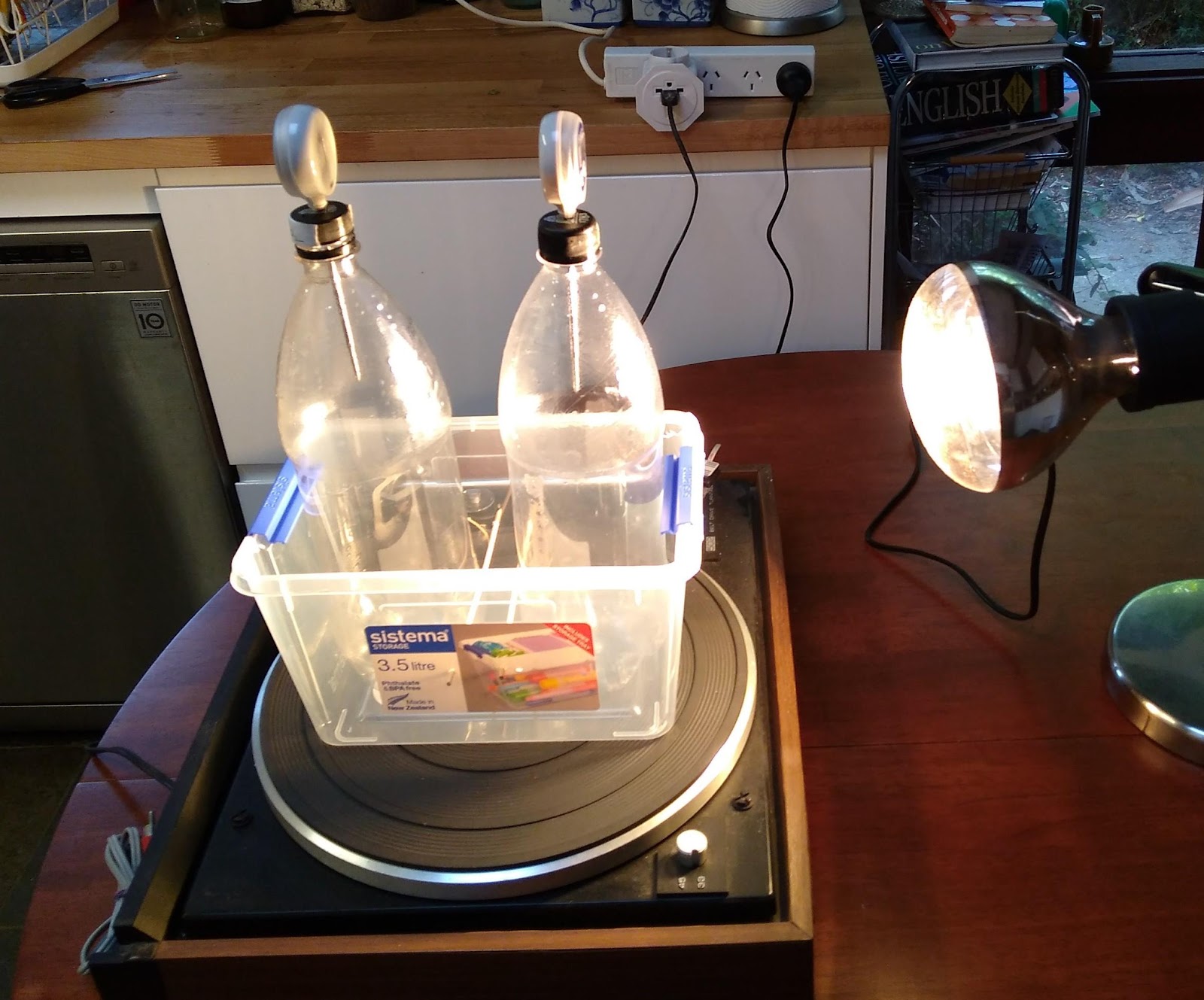
Greenhouse gas demonstration


The effect of carbon dioxide on the atmosphere has been studied experimentally since 1856, when Ms Eunice Foote compared the warming of two flasks, one filled with “carbonic acid gas”, when they were simply placed in direct sunlight (1). Now, thanks to Warwick Cathro at 350.org Canberra, here is a neat way to reproduce this classic demonstration, ideal for a winter science fair, as we discovered.

Monday, 12 August 2019

Thank you for joining in with thinking outside the planet


Thank you to everyone who took part in the 8th August Earth System education event as part of warming up to 2019 Science Week here in the ACT.
Thank you to the Science Educators Association ACT, the ACT Chapter Environmental Education and Caroline Chisholm School's Centre for Innovation in Learning for partnering and hosting the event.

Thanks to Angela Colliver Consulting, Dancekids, Nature Art Lab and the Australian Academy of Science for sharing materials for educators. Finally, thank you Inez Harker-Schuch - ANU and the University of Copenhagen - for the stimulating presentation.

Stay tuned as over the next month we load up this new AAEE blog with plenty of local environmental education goodies.

Wednesday, 31 July 2019

Tipping points, planetary boundaries and safe operating spaces


2019 marks 10 years since the first publication of the 'planetary boundaries' concept in the scientific literature.

The Planetary Boundaries concept identifies nine global priorities relating to human-induced changes to the environment. The science shows that these nine processes and systems regulate the stability and resilience of the Earth System — the interactions of land, ocean, atmosphere and life that together provide conditions upon which our societies depend. Four of nine planetary boundaries have now been crossed as a result of human activity: climate change, loss of biosphere integrity, land-system change, altered biogeochemical cycles (phosphorus and nitrogen). Two of these, climate change and biosphere integrity, are what the scientists call "core boundaries". Significantly altering either of these core boundaries would drive the Earth System into a new state.
Like the concept of the Anthropocene, the Planetary Boundaries is a concept underpinned by decades of work in the emerging field of Earth System science.

Over the last 2 years environmental educators in the ACT have been lucky enough to be able to meet up on a semi-regular basis with one of the field's most innovative, well regarded - and approachable - Earth System scientists, Canberra-based Professor Will Steffen.

It turns out that there is a good chance that in Canberra there is a sufficient critical mass of interest and capacity to develop some high quality secondary and primary teaching materials based on these concepts, with work starting on just that in late 2019. If that sounds interesting to you just let AAEE know at aaeeact@gmail.com If you are on facebook, why not join the AAEE Earth System Science and Planetary Boundaries Special Interest Group here. Read our page 'Earth System Education' here.

Read more:

Will Steffen's 2017 AAEEACT presentation slides (2 boundaries, climate and biosphere integrity).
A Good Life For All Within Planetary Boundaries https://goodlife.leeds.ac.uk - a great starting point, based on research recently published in Nature Sustainability. Interactive world map here.
Clickable animation http://www.anthropocene.info/planetary-boundaries.php